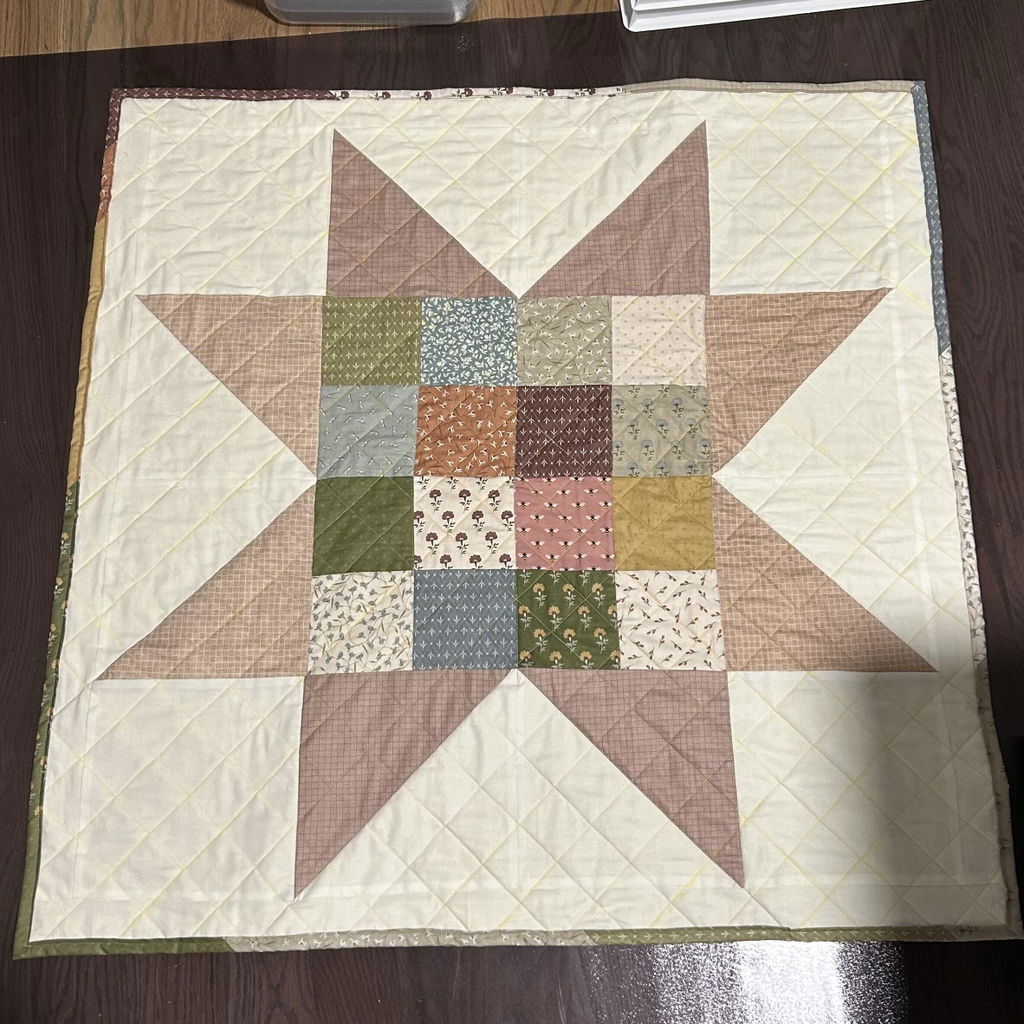

How to Make a Scrap Quilt Look Cohesive: 10 Tips for Successful Scrap Quilts
Scrap quilts are a wonderful way to use the fabric you already have, but how do you make a scrap quilt look cohesive rather than messy?
The secret isn't making every fabric match. A successful scrap quilt usually has some form of visual structure that holds all those different fabrics together. Contrast, value, repetition, colour, print scale and fabric placement can all help create that structure.
You don't need to use every strategy below. Often, choosing just one or two simple rules is enough to turn a collection of unrelated scraps into a quilt that feels intentionally scrappy.
1. Use Contrast to Define the Quilt Design
Good contrast is one of the most important elements of a successful scrap quilt, particularly when you want the block design to remain clearly visible.
Contrast can come from colour, but value contrast is particularly useful in quilting. Value describes how light or dark a fabric appears.
Two fabrics can be completely different colours but have a very similar value. A pale pink and pale blue, for example, may blend together when placed side by side. Pairing a light fabric with a medium or dark fabric creates much stronger definition.
If your scrap quilt looks busy or the block design seems to be disappearing, insufficient value contrast may be the problem.
Quick tip: Take a photograph of your fabric selection or quilt blocks and convert it to black and white. Without colour to distract you, it becomes much easier to see whether you have a good distribution of light, medium and dark fabrics.
The image below shows the my Nine Patch Chain quilt. The use of dark and light fabric squares creates the chain pattern. The pattern is available here.

2. Give the Eye Somewhere to Rest
When every fabric is competing for attention, a scrap quilt can quickly become visually overwhelming.
Introducing quieter fabrics gives the eye somewhere to rest.
This might be a solid, low-volume print or neutral fabric that appears throughout the quilt. And a neutral doesn't necessarily have to be white, cream or grey. Navy, black, denim blue or another relatively consistent colour can perform the same job.
Using one background fabric throughout a scrap quilt is one of the simplest ways to bring a large assortment of fabrics together.
The image below shows the Clippings quilt. Although it is very scrappy, the dark neutral fabric ties the whole quilt together. The pattern is available here.

3. Repeat Something Throughout the Quilt
Repetition creates visual rhythm and is one of the easiest ways to make a scrap quilt look cohesive.
You might repeat the same background fabric, include a particular colour in every block, use the same fabric in several areas of the quilt or place a particular colour in the same position within each block.
The individual scraps can change enormously while the repeated element provides continuity.
This strategy is particularly useful if your scrap collection contains fabrics from many different designers, collections or years.
The image below shows the Buttons and Bows quilt. In this quilt, I have used the same black and white check in centre of each block. This ties all the blocks together and feel cohesive. Pattern available here.

4. Try a Controlled Scrappy Quilt
If using your entire scrap collection feels overwhelming, try a controlled scrappy approach.
A controlled scrappy quilt uses lots of different fabrics while following one or more predetermined rules. You might restrict the quilt to a particular colour palette, use the same background throughout or maintain a consistent value arrangement within each block.
For example, choose only blues and greens from your scrap collection. You can still use dozens of different fabrics, but limiting the colour palette gives them something in common.
Another approach is to make each block its own little colour story. One block might contain coordinating blues, another greens and another pinks. The finished quilt remains very scrappy, but each individual block has some structure.
Controlled scrappy quilting gives you the variety of a scrap quilt without having to leave every fabric choice completely to chance.
Below is the Electrolite quilt. Each star contains a pair of fabrics that are co-ordinated. My method for co-ordinating each star is discussed further in this blog post. The dark neutral is used to unify the whole quilt and the low volume fabrics are used to give the eyes a place to rest.
The Electrolite quilt pattern is available here.

5. Mix Different Print Scales
Print scale can make a surprising difference to the overall appearance of a scrap quilt.
If every fabric contains a large, bold print, the quilt may become visually crowded. Mixing larger prints with small-scale prints, geometrics, blenders, low-volume fabrics and solids creates more variation.
Remember that prints can look very different once they're cut into small pieces.
A large floral that dominates a fat quarter may become an interesting combination of colours once it's cut into a 1½" square. Don't automatically dismiss a fabric because you think its print is too large. Look at the section that will actually appear in the finished patch.
In the Flicker From View Quilt pattern shown below. I have used low volume for the sashing which gives a place for the eyes to rest. I have varied the scale of the prints to create interest as the eye moves around the quilt. There are large, medium and small scale prints. I have varied the style of prints as well and included florals, geometrics and novelty prints. Flicker From View quilt pattern is available here.

6. Spread Strong Colours and Prints Around
We all have scraps that demand attention.
Perhaps it's a very bright yellow, a strong black-and-white print or an unusually saturated colour. Instead of clustering these fabrics in one area, distribute them throughout the quilt.
The same applies to very light and very dark fabrics.
This helps create visual balance and prevents one section of the quilt from appearing much heavier, brighter or darker than another.
Periodically step back from your design wall or take a photograph of the quilt. Seeing the entire quilt at a smaller scale often makes uneven areas much easier to spot.
In the Olive and Nell quilt, I didn't want any of the blocks to dominate and avoided too many saturated colours. Almost all the colours are "medium values". The Olive and Nell quilt is available here.

7. Let the Quilt Block Provide the Structure
The greater the variety in your fabrics, the more useful a strong repeating quilt block can be.
Traditional and geometric blocks such as Log Cabin blocks, stars, Flying Geese, Pineapple blocks and Nine Patches work particularly well for scrap quilts because the repeated shapes provide an underlying structure.
Every block can contain different fabrics while the repeated geometry ties the quilt together.
This is one reason traditional quilt blocks lend themselves so beautifully to scrap quilting. The fabrics may change from block to block, but the structure remains familiar.
The Oliver Quilt pattern repeats the crosses and circles and combined with the restricted colour palette of blues, teals and yellows/browns, creates a cohesive scrappy quilt. The Oliver Quilt pattern is available here.

8. Sort Your Scraps Before You Start
You don't need an elaborate scrap storage system, but a little sorting before you begin can make choosing fabrics much easier.
Try sorting your scraps by colour, value, warm and cool colours, print scale or fabric type. For some projects, sorting by physical size is useful too. Keep strips together, small squares together and larger pieces together.
Once the fabrics are spread into groups, you'll often discover combinations that weren't obvious when everything was sitting together in a scrap bin.
It can also show you where there are gaps. Perhaps you have plenty of medium-value fabrics but need more lights and darks to create contrast.
I sort of scraps and stash by colour groups eg blues, greens, reds/pinks, browns, yellows, oranges, low volumes and greys etc. I store my large prints and novelty fabrics separately.
The quilt below is my Another Story quilt which utilises large print fabrics. Pattern available here. A single background fabric is used to give somewhere for the eyes to rest and tie all the fabrics together.

9. Make a Few Test Blocks
Before cutting enough fabric for an entire scrap quilt, make a few blocks and place them together.
This is often the quickest way to discover whether your original plan is working.
You might realise that you need more dark fabrics, fewer large prints or a little more repetition. Or you might discover that the fabric combination you weren't quite sure about looks wonderful once several blocks are together.
A test block is much easier to adjust than an entire quilt.
I often make two thirds of a quilt, pause and take stock of what I have made so far. I assess whether it is looking too dark or too light or contains too much of one colour and looks unbalanced. Then I will try and rectify the balance with the remaining third of the blocks.
10. Don't Try to Control Everything
There is also a point where a scrap quilt can become too controlled.
Part of the appeal of scrap quilting is discovering unexpected fabric combinations as you sew. A fabric you would never have chosen for a carefully coordinated three-fabric quilt might be exactly what makes your scrap quilt interesting.
Instead of trying to make every fabric match, choose one or two rules for your quilt.
For example:
Anything goes, but there must be strong contrast within each block.
Or:
Use any blue or green scrap, with the same neutral background throughout.
Or:
Every star can be a different colour, but each star uses two coordinating fabrics.
Once you've established your rule, you can relax a little with everything else.
What Makes a Successful Scrap Quilt?
A successful scrap quilt isn't necessarily one where all the fabrics coordinate. It's one where the variety feels intentional.
Contrast can define the shapes. Repetition can create rhythm. A consistent background can provide somewhere for the eye to rest. A limited colour palette can bring unrelated fabrics together. And a strong repeating block can provide structure.
You don't need to use all of these strategies in the same quilt.
Sometimes one simple decision is enough.
Then you can let your scraps do what scraps do best: add colour, variety, memories and those unexpected combinations that you probably wouldn't have planned if you'd bought all the fabric specifically for the quilt.
And perhaps that's the best part of making a scrap quilt. You already have the fabric. The fun is discovering how well those seemingly unrelated pieces can work together.
Frequently Asked Questions About Scrap Quilts
How do you make a scrap quilt look cohesive?
Create at least one consistent element throughout the quilt. This could be a repeated background fabric, limited colour palette, strong value contrast, repeating block design or consistent fabric placement. Your scraps don't all need to match if another element provides visual structure.
What is a controlled scrappy quilt?
A controlled scrappy quilt uses a variety of fabrics within a set of predetermined rules. For example, you might use many different scraps but limit them to three colour families, use the same neutral throughout or maintain the same light-and-dark arrangement in every block.
Do fabrics in a scrap quilt need to match?
No. Scrap quilt fabrics don't need to come from the same collection or even have the same style. Contrast, repetition, value and colour distribution can help unrelated fabrics work together.
How many colours should I use in a scrap quilt?
There is no ideal number. A controlled scrap quilt might use two or three colour families, while another successful scrap quilt could contain almost every colour. The more variety you introduce, the more useful other elements such as value, repetition and a strong block design can become.
How do I stop a scrap quilt from looking too busy?
Try introducing quieter fabrics, increasing value contrast and repeating some fabrics or colours throughout the quilt. You can also use a consistent background or neutral fabric to provide visual breathing space. Stepping back or photographing your quilt can help identify areas where strong prints or colours have become concentrated.
You May also like to read
Tips for creating controlled scrappy quilts